Pursuing Excellence in Design and Technology - Raj Lal

Tuesday, April 1, 2014

My article at MSDN magazine on Camera Apps for Lumia 1020


Here is my presentation at Silicon Valley Code Conference which gave me the idea of this article.

Build an Advanced Camera App for Nokia Lumia Phones

Rajesh Lal

Excerpt from the article... http://msdn.microsoft.com/en-us/magazine/dn630649.aspx

In this article, I’m going to teach you how to develop an app for the 41-megapixel (MP) Nokia Lumia 1020 and 20MP Nokia Lumia 1520 smartphones. I’ll focus primarily on the Nokia Lumia 1020, but the information applies to all Lumia Windows Phone 8 devices with PureView technology. First, I’ll discuss PureView, the technology behind the powerful camera included in the phones, and then I’ll explain the advanced features available to access and enhance your photographs. I’ll provide an overview of the Nokia Imaging SDK (it has tons of ready-to-use graphic filters) and a walk-through of how to use it. I’ll also cover the typical workflow needed to build a camera app and show you how to create a tilt-shift photo filter to simulate shallow depth of field. Let’s get started.

Understanding the PureView Technology in a 41MP Camera Phone
PureView technology consists of advanced camera hardware and related software. Together, they allow the capturing and saving of high-quality, high-resolution images. The three main aspects of PureView technology are a high-resolution camera lens, oversampling and lossless zoom. I’ll briefly explain each one.

The core of PureView technology is a high-resolution sensor, 7,728 pixels wide and 5,368 pixels high, totaling more than 41MP. This enables the camera phone to capture big photographs, six times larger than a normal 5MP photograph.

Figure 1 compares a 41MP resolution picture with a 5MP resolution picture. Because of this 41MP resolution, you can take high-quality 34MP 16:9 photographs (7,728 x 4,354) as well as 38MP 4:3 photographs (7,152 x 5,368), as shown in the lens view of the camera in Figure 2.

A 41MP Picture Compared with a 5MP Picture


Figure 1 A 41MP Picture Compared with a 5MP Picture

Lossless Zoom Is Still Part of the Photograph Figure 2 Lossless Zoom Is Still Part of the Photograph

Pixel oversampling is when the camera takes a 41MP photograph and creates a high-quality 5MP image. This is the picture you see on the phone’s screen. Furthermore, the oversampling process keeps all the rich detail in the image but filters away any visual noise.

The third aspect of PureView technology is lossless zoom, which simply means you don’t lose image quality when you zoom. This is possible because—at any point in time—you have available the original 41MP picture, which is oversampled to show a 5MP photo. When you zoom, you’re really zooming into a part of the original 41MP photo. At up to a 3x zoom, you’re still dealing with parts of the original 41MP photo. And even at maximum zoom, your photo quality is still the quality of a regular 5MP photo. Due to oversampling, the picture quality only gets better as you zoom. Figure 2 shows how the lossless zoom is still part of the original photograph.

The Nokia Imaging SDK When building a camera app, a high-resolution photograph is the raw material, but you’ll need an advanced software stack that can use the huge images and let you access and manipulate them. This is where the Nokia Imaging SDK comes into the picture (bit.ly/1hJkmpl). It provides a set of advanced features to access a high-resolution photograph taken by the camera.

The Nokia Imaging SDK includes partial JPEG decoding, called Random Access JPEG (RAJPEG) technology. RAJPEG allows for random access of JPEG data, fast downscaling of images and instant partial decoding. These aspects of RAJPEG enable real-time image manipulation. The Nokia Imaging SDK contains more than 50 filters, effects and enhancements. It even contains a set of the most common image operations, such as crop, resize, rotate and undo, just to name a few. These out-of-the-box features help you create advanced camera/photo-centric applications without worrying about the most common functionalities. To use the Nokia Imaging SDK in your project, follow the instructions on the Nokia Lumia Developer Library page (bit.ly/KzDPNG).

Checkout the complete article here http://msdn.microsoft.com/en-us/magazine/dn630649.aspx

Labels: , ,

Saturday, January 4, 2014

CHOICE Reviews Digital Design Essentials as Recommended -- A. R. Hutchinson, Will Smithsonian Institution Libraries

Digital Design Essentials book reviewed by CHOICE magazine, a premier source for reviews of academic books, electronic media, and Internet resources of interest'

ChoiceCover

"This reference work illustrates 100 usability design tips for websites and other applications across devices, not only for aesthetics but also for functionality and ease of use. Lal, a digital product designer, addresses advanced website functions, including the creation of a shopping cart, reviews and ratings, mobile commerce, touch screen interfaces, infographics, APIs, and other current technologies. Each topic features a short instructional page with bullet-point recommendations and tips on what to include. A facing page shows real-world examples and/or case studies. Some of the text instructions refer readers to other entries with related design concepts. The content, organized into sections titled "Desktop," "Web," "Mobile," and "Miscellaneous," is well indexed. Rather than being a technical manual on how to create websites, widgets, or other applications, this volume presents best practices from an ease-of-use perspective. The examples undoubtedly will become outdated soon, but they represent some of the best illustrations of contemporary usability design. The rapid evolution of technology means that few books are available to compare with this one. It will be useful to those interested and/or active in web development or mobile app development.

Summing Up: Recommended. Lower- and upper-level undergraduates, general readers, professionals/practitioners.

--A. R. Hutchinson, Will Smithsonian Institution Libraries Copyright 2013 American Library The Association

Choice Review for Digital Design Essentials - http://www.cro3.org/content/51/03/51-1238.full

Labels: , ,

Tuesday, June 4, 2013

Digital Design Essentials: An Ultimate guide to Human Comuter Interaction

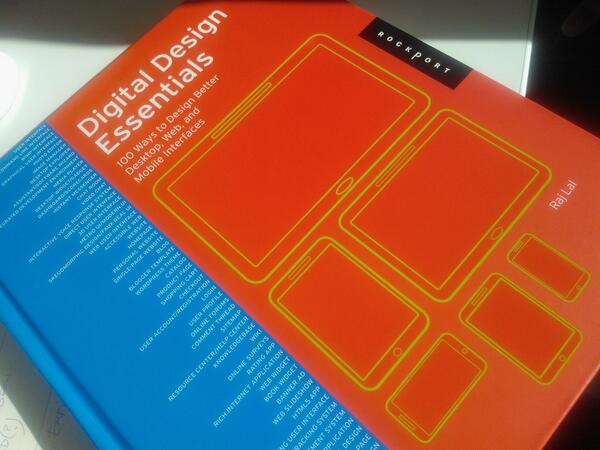
Finally my two years of hard work, one interface design per week for 100 weeks, magically turned into a hardcover book by rockport publishers. The overwhelming experience when you see your own book for the first time. Oh my! Tears of Joy is not just a statement, it actually happens. ok, before I get carried away, here is the picture, not of the tears, of the book.

Digital Design Essentials: 100 ways to design better desktop, web, and mobile interfaces?

An ultimate guide to human computer interaction.


Check out the digital design essentials book at amazon.

Labels: , , ,

Friday, March 29, 2013

Digital Design Essentials: 100 ways to design better desktop, web, and mobile interfaces

I got an email from my publisher that my book on digital design is going to be out and available by May 1.

check the digital design book at amazon.com

Check the Digital Design book at Amazon

Digital Design Essentials takes a practical, highly accessible approach to creating graphical user interface designs for desktop, mobile, and touch screen devices. Written by an expert in the realm of digital design, this comprehensive, step-by-step guide demonstrates how to apply design principles in a variety of desktops, web pages, mobile devices and other touchscreens. Filled with straightforward strategies in a visual format, it’s an essential volume for any designer working in the digital realm.

Here is the information about the book from the jacket cover

Digital Design Essentials

Whether dashboard software or a single-page website, a location-aware mobile app or a 10-foot TV interface, digital design is the tip of the iceberg; the actual design is not how it looks but how it works. Dive deep into the workings of one hundred popular desktop, Web, mobile, and TV user interfaces. Digital Design Essentials is a comprehensive, cross-disciplinary encyclopedia of user interface design. Richly illustrated and easy to navigate, it includes architectural views of the application, best practices and design guidelines, tips for creating a great user experience, along with live examples. Every major user interface concept is defined and illustrated for readers, including command line, "WIMP,” metro UI, skeuomorphic design, accessible web interface, e-commerce, zooming user interface, infographic design, adaptive interface, mobile lifestyle apps, voice interface, and intelligent user interface.

Learn best practices, design guidelines and pointers for creating a compelling user experience. Digital Design Essentials provides the experienced designer with an understanding of application design and user interfaces. Raj Lal points out the different components affecting the user experience and design principles applicable in an array of application interfaces, enabling the reader to understand the inner working of the application, plan key features, apply design guidelines, and choose the best practices instead of reinventing the wheel.

Digital Design Essentials:

● Provides a comprehensive guide to user interface design
● Explains the know-how necessary to understand the application interface
● Points out components affecting the user’s experience of the application
● Provides user interface design guidelines and best practices for design
● Illustrates concepts with a case study for each essential, using real-life examples


Digital Design Essentials is an invaluable resource for graphic artists, UI designers, UX gurus, Web designers, RIA, mobile, and device developers.

Labels: , , ,

Sunday, December 9, 2012

10 principles of clear writing

From the book the power of simplicity, here are 10 principles of clear writing.

1. Keep sentences short.
2. Pick the simple word over the complex word.
3. Choose the familiar word.
4. Avoid unnecessary words.
5. Put action in your verbs.
6. Write like you talk.
7. Use terms your readers can picture.
8. Tie in with your reader's experience (The essence of positioning)
9. Make full use of variety.
10.write to express, not impress.


Nice gem of a collection.

Labels: , ,

Monday, December 3, 2012

My Article on Accessible HTML5 design published on MSDN magazine

Check here Building HTML5 Applications - Designing Accessibility with HTML5


Thanks go to Dennis Lembrée, Art Barstow and Lakshmi for reviewing it.

http://msdn.microsoft.com/en-us/magazine/jj863135.aspx

Here is the brief on the article

Designing Accessibility with HTML5


If you’re truly interested in reaching a broad audience, you’ll want to design your Web site for accessibility. Accessibility is about making Web pages easier to access, easier to use and available to everyone. In general, using the latest technologies makes accessibility easier to accomplish. Today, that means using HTML5.

To be accessible, your content needs to be available on a broad range of devices, such as ordinary computers using a keyboard or mouse, screen readers, audio browsers, devices with limited bandwidth, old browsers and computers, and mobile phones and touch devices. Moreover, it should be reachable by the widest variety of people, including those with disabilities and senior citizens, as well as people with low literacy levels or temporary illness, or who prefer using only a keyboard or mouse.

    The four key areas disability accessibility seeks to address are:
  • Hearing
  • Mobility
  • Cognitive
  • Visual


Check rest of the Accessible design article at MSDN

Let me know what you think.

Labels: , ,

Saturday, May 26, 2012

Fun with Silverlight 4 with VB.NET

The VB.NET Version of the popular book "Fun with Silverlight 4" is now available at Amazon. Amazon link for VB.NET book

Check out some of the amazing review on the book at amazon !

Simple, concise, instructive and informative - Tim Heuer, Microsoft (Redmond, WA) (On C# version of the Book ) "This is a great book for someone looking to get a broad view of the Silverlight 4 platform. It is very simple to read/understand for anyone wanting to get started. The book is very illustrative - literally - to provide good visuals about each of the core concepts. At the end of reading this book and following the examples, the reader should be able to quickly start building "real" applications using the basic concepts. ... Recommend."

"Handy guide for you to find specific solutions you want to achieve in Silverlight 4" - Kunal Chowdhury, a Silverlight MVP

This book illustrates more than 100 features in Silverlight using a simple problem/solution approach. It takes one feature at a time and guides you in progressive journey where you begin by using the basic components, then by creating graphics and animations. You then create rich media applications on the client and web services, and delve into calling advanced Web services like AJAX, REST and WCF services from Silverlight.

The book takes an example approach for all problems and features, and illustrates with class diagrams what objects and methods are used and how the elements of a Silverlight project are created in easy to understand format.

    In the Book
  • Design a Rich Internet Application
  • Extend the Control Framework
  • Create Compelling Graphics
  • Work with Animation
  • Extend the Browser Programming Model
  • Bring Data Visualization to the Web
  • Develop with ASP.NET and Ajax
  • Work with Web Services
  • Create Rich Silverlight Media Applications
  • Deliver Enhanced and Interactive Streaming Video Experiences

The book assumes the reader has a basic understanding of web technologies and .Net programming languages, and is targeted at the intermediate to advanced Silverlight developer.

Amazon link for VB.NET book

Kindle edition of Fun with Silverlight 4 with VB.NET

Amazon link for Kindle edition of Fun with Silverlight 4 with VB.NET

Labels: , , ,

Sunday, November 20, 2011

Fun with Silverlight 4 Book

The book is finally available at Amazon and other book stores.


Buy from Amazon http://www.amazon.com/Fun-Silverlight-Illustrated-Creating-Applications/dp/1463506023/

It took more than 3 years to finish this 600 page long book.

Fun with Silverlight 4

The Illustrated Guide to Creating Rich Internet Application with Examples in C#, ASP.NET, XAML, Media, Webcam, AJAX, REST & Web Services.

This book illustrates more than 100 features in Silverlight using a simple problem/solution approach. It takes one feature at a time and guides you in progressive journey where you begin by using the basic components, then by creating graphics and animations. You then create rich media applications on the client and web services, and delve into calling advanced Web services like AJAX, REST and WCF services from Silverlight.

In the Book
---------------
1. Design a Rich Internet Application
2. Extend the Control Framework
3. Create Compelling Graphics
4. Work with Animation
5. Extend the Browser Programming Model
6. Bring Data Visualization to the Web
7. Develop with ASP.NET and Ajax
8. Work with Web Services
9. Create Rich Silverlight Media Applications
10. Deliver Enhanced and Interactive Streaming Video Experiences

Labels: , ,

Saturday, November 19, 2011

Fun with Silverlight 4, Available Now Hot off the press !

Finally the book I have been working for last 3 years sees the light of the day. The book will be available at amazon, b&n, and other book stores in few days, but it is available to order Hot Off the Press

Get the Book "Fun with Silverlight 4" here https://www.createspace.com/3616306


More information about the book at http://silverlightfun.com

Labels: , ,

Thursday, November 3, 2011

3D with Silverlight: My article at MSDN magazine

Learn 3D with Silverlight, at MSDN Magazine


Great review about the article - Mike James, I Programmer,

"Silverlight 3D for me this article was the star of the show. It is about three different ways to create a rotating 3D cube in Silverlight. After some basic theory it explains how to do the job in Silverlight 4 first using rectangles and projections and then using bitmap images. The third method however is much more satisfactory - using XNA with Silverlight 5. Can't wait for Silverlight 5!"


Here is excerpts from my article, let me know if you find it useful.

Developing 3D Objects in Silverlight


In this article, I’ll show you how to develop 3D objects in Silverlight. I’ll start with a brief background on 3D and then look at some of the advanced features available in Silverlight that enable creation and display of 3D objects. I’ll take a simple example of a cube and show you three different ways to create 3D transformations. I’ll also explain what key elements you need to display a 3D object on a computer screen. Finally, I’ll explore how Silverlight 5 will allow you to go beyond what’s available today and create much richer 3D objects.

Silverlight supports a right-handed coordinate system, which means the positive z axis is pointing toward the viewer (see Figure1). There are three main elements of 3D that are needed for displaying an object on the screen:

* Perspective
* Transformation
* Effect of light

More .... check at Developing 3D Objects in Silverlight at MSDN Magazine

For the book Fun with Silverlight 4

Labels: , ,

Monday, October 10, 2011

Steve Jobs: Tribute to a legend

Here are my favorite 7 Quotes from Steve jobs.

1. Computers are like a bicycle for our minds.


2. Good artists copy great artists steal


3. Design is not just what it looks like and feels like. Design is how it works.


4. Do you want to spend the rest of your life selling sugared water or do you want a chance to change the world? - To get John Sculley as Apple's CEO

5. Make it like a sunflower.
Steve Jobs, CEO, Apple, to Johnathan Ive, Vice President of Design, Apple, on prev version of iMac

6. Here's to the crazy ones, the misfits, the rebels, the troublemakers, the round pegs in the square holes... the ones who see things differently -- they're not fond of rules... You can quote them, disagree with them, glorify or vilify them, but the only thing you can't do is ignore them because they change things... they push the human race forward, and while some may see them as the crazy ones, we see genius, because the ones who are crazy enough to think that they can change the world, are the ones who do. -- narrated by Steve Jobs


7. Be a yardstick of quality. Some people aren't used to an environment where excellence is expected.

8. Innovation distinguishes between a leader and a follower.

9. When you’re a carpenter making a beautiful chest of drawers, you’re not going to use a piece of plywood on the back, even though it faces the wall and nobody will ever see it. You’ll know it’s there, so you’re going to use a beautiful piece of wood on the back. For you to sleep well at night, the aesthetic, the quality, has to be carried all the way through.”

10. “Click. Boom. Amazing!” – Macworld keynote 2006

11. "I would trade all of my technology for an afternoon with Socrates."
—Newsweek, 2001

12. "I want to put a ding in the universe."

13. I make 50 cents for showing up ... and the other 50 cents is based on my performance.
On his famous $1 annual salary, at the annual Apple shareholder meeting in 2007, as quoted in "Jobs: 'I make fifty cents just for showing up'" in AppleInsider (10 May 2007)

14. “I’m convinced that about half of what separates the successful entrepreneurs from the non-successful ones is pure perseverance.”

15. People with passion can change the world for better !

Labels: , ,

Wednesday, September 14, 2011

Better Presenter than Steve Jobs ?

I never thought I will write a blog with this title. I have learned a lot from Steve Jobs after my target of 2009, but recently I came across a presentation on "Patterns of Human Interaction" by Marko Ahtisaari (Global head of Nokia Design) at Copenhagen Design Week, which not only blew my mind, but changed my perspective about presentation all together.


About the presentation
Five billion people have a mobile phone. Today, no single, technological device is more in our hands than the mobile phone – it has become the media through which humans interact.


Marko Ahtisaari is the global head of Nokia's design unit, and he is responsible for Nokia’s product and user experience design. During Copenhagen Design Week, Marko shared Nokia’s thoughts on how design will shape and influence the patterns of human interaction in the future at a Nokia event at Bella Sky Hotel.


What I found unique about the presentation is, Marko leaves a deeper impact without trying hard to sell. Its plane awesome, and it is modest and it is honest, which I think appeals to everybody equally. Marko is well dressed and extremely efficient in his walk, and he talk with a very positive body language. He always seems to be at ease and is smiling most of the time in a most friendly manner. Each of his words tell, he is clear and concise, he does not repeat, he does not overstate, his words all fit precisely in his talk. He makes a point he is trying to make, in a straight forward and most effective manner. And most important of all his presentation does not even have any bells and whistles. Blank white screen with a white door ! Most of the first few pages are hand drawn concepts or a single image. No chimming sounds, no explosion effects and no cutting edge graphics. 


Absolutely awesome ! My new idol ! If you want to learn how to present well learn from him Marko Ahtisaari (The Best presenter I have seen in the world). Each and everything he does is simple, yet mind blowing.

That also reminded me of something very unique, when I joined Nokia 2 1/2 years ago. I came to know that Nokia is all about "Being Humble" and I think thats the finiish culture completely opposite of American culture, which is a bit more aggressive salesmanship like ofcourse Steve Jobs.


Thank You for the Inspiration Marco Ahtisaari


Here are excerpts from another blog about the same presentation .


http://raesmaa.wordpress.com/2011/09/10/the-finnish-awesomeness-and-entrepreneurship/


The Finnish Way of Being
Serendipitously I happened to bump into another type of Finnish awesomeness.  I listened to Senior VP of Design at Nokia Marko Ahtisaari’s presentation at the Copenhagen Design Week.
The first 12 minutes (the rest of it is mostly about Nokia design and future development, interesting as well) of his speech ‘Patterns of Human Interaction’ had an effect on me. His humble way of speaking about how better design can help us to make each other feel that we are welcome, is just awesome. A beautiful perspective! 


Another observation I made is his style of speaking, it is very Finnish (read: very non-American). He is not shouting and feverishly waving his hands – no, instead he applies the traditional Finnish style: he is calm, speaks very softly and is overall adorable and kind. And all that without being boring. It kind of reminds me of the way Facebook’s COO Sheryl Sandberg speaks. Or Alex Osterwalder, or Aalto Entrepreneurship Society’s president Miki Kuusi. So I warmly recommend you to listen to Marko, at least the first 12 minutes.


Small Talk and Positive Silence


These great people and the two events – AaltoES with Steve Blank & Marko Ahtisaari and his talk about more human design principles – made me think about what is “Finnishness”, and why I’ll find it awesome and full of possibilities for the entrepreneurship too.
The Finnishness?, you may ask. Yes, we do have some national characteristics that can be more rare among other nationalities, we can be seen as very shy, but on the other hand our curiosity and creativity makes it easy for us to connect and share. To connect and share, and most importantly to listen. On top of that we are very persistent and diligent; we don’t like to give in. Except in football.
We Finns can easily be silent in company with other people. It’s natural. Foreigners often find our silence odd, or fascinating. Professor of Communication Donal Carbaugh, from University of Massachusetts at Amherst, have written an excellent paper about this – Silence and Quietude as a Finnish“Natural Way of Being” [pdf], with the following description:


“A Finnish communication code that structures some cultural scenes as occasions for positive silence, exhibiting a social model of personhood for which this is a valued, respected, and natural practice.”


I just love this expression, positive silence. Please consider positive silence as time for thinking, reflecting, and listening. The paper explains the Finnish way of communication with many good example stories; it can truly help in understanding us Finns…


Another great read is this short article of the Helsinki Times – No small talk please, we’re Finnish, in which freelance journalist Susan Fourtané describes her experiences:


“I particularly enjoyed the thoughtfulness and the moments of silence in between, giving space for observing our own thoughts before speaking. Yes, you have heard it right. Finns don’t do small talk. They don’t think a moment of shared silence is awkward. On the contrary, it is part of the conversation. A direct question gets a direct answer. There is no nonsense talk about nothing. There is no asking “How are you?” ten times until someone says something else, or stating the obvious. Finns are more interested in how you think, how you perceive Finland or what keeps you in this small and cold country, as they refer to beautiful and peaceful Finland.”


Less small talk and more positive silence, I believe that this enables better listening, and further better understanding.

Labels: , , ,

Thursday, September 8, 2011

Exposure Reaction Mantra

I stumbled into this mantra of Exposure Reaction. Eye opener !

Exposure :Reaction
--------------------------------------------
First “ : So what!”
Second “ : What’s in it for me?”
Third “ : That’s interesting.”
Fourth “ : What was that title again?”
Fifth “ : I think I’ve heard of that book before.”
Sixth “ : I think I’ve heard of that author before.”
Seventh “ : My friend mentioned that book yesterday.”
Eighth :“ My friend read it and thought it was good.”
Ninth “ : I’ll look for it when I’m at the book store.”
Tenth “ : I’ll go to the store to buy it now.”
--------------------------------------------

This was meant for book promotion but i think it can be applied to any sales/marketing strategy.

Labels: ,

Saturday, July 2, 2011

Most Important Intellectual Habit of Man

Concentrate on your goal, is one thing you need to do, to achieve it. But concentration is not easy. Here are few tips to help you concentrate, it works for me so I hope it will work for you too.

1. Do One thing at a time, at all time. Do work sequentially, concentrate on one work at a time, avoid multitasking. finish one and then go to next

2. Before starting a challenging task, relax, do what you love to do, be creative, have fun, read books

3. Next step is free your mind from "Hurry, Worry, and Fear" and all distractions to attain peace of mind

4. Create a clutter free, clean, quite and solitary place to work, a distraction free environment, which is pleasant and where you can work alone without interruptions. Remove all you distractions away like cell phones, ipads, internet, emails, etc.

5. Make a daily schedule and limit your time to work, less is always more in concentration, when you have less time you give full concentration. If you have infinite amount of time nothing gets done

"Concentration is the Most Important Intellectual Habit of Man."


Not one person in ten thousand can really concentrate.

Some realize that they do not know how—others drift along the line of least resistance and let their minds vegetate, apparently never suspecting their weakness or realizing that they are an utter failure at concentration. To Cori-centre—bringing all your mental force and faculties to bear steadily on a given center with-out deviation from that exact point—whipping into line all wandering fancies—stray ideas or thoughts that go off on a tangent—to hold steadily all your power on the central thing under consideration without an instant of wavering—that is Concentration.


This ONE THING I Do

A difficult thing to do, and very few minds can do it. St. Paul gives us the shortest definition of concentration on record when he says, " This one thing I do," short, but tremendously significant.

Another Bible definition is excellent: " Whatsoever thy hand findeth to do, do it with thy might." Some men work that way, intense fellows--brilliant professional men—big business men—executives—leaders in the world of finance—science—invention—literature—education—it matters not what kind of work, the point is that when these men pitch hay, they pitch hay —when they write a book, they write a book—when they manage a sales campaign, they man-age a sales campaign. That one thing they do at that one time, and nothing else, and every ounce they have goes into the doing. But back of all this has been a lot of mental discipline, a lot of habit-forming, a lot of brain-building. Let us consider some of the steps by which they have climbed. To the ambitious student, I offer five practical aids to concentration, planned to meet the needs of one who wishes to build from the ground up. We must assume as prerequisites, interest and attention, which have already been discussed.

AIDS TO CONCENTRATION

These aids will do more than help you to follow a memory course; they deal with your daily work. Concentration applies to all the activities of life. It should be established as a life habit. To all who think, I bring this message, Think it with thy might. Make a business of doing one thing at a time with all your soul. Chesterfield was right when he said, " There is time enough for everything in the course of a day if we do but one thing at a time, but there is not time enough in a year if we try to do two things at a time."

1. PERIODICAL RELAXATION

It may seem paradoxical that the first aid to better concentration refers to relaxation. But I have observed that some of the most intense intellects fail in their concentration because they never relax. Failure to let go between efforts is their chief stumbling block. They keep them-selves tense, nervous, " keyed-up " all the time, even when there is no need for it, thereby wasting nervous energy.

They find it very difficult to " let go "—to relieve the high-tension by a little natural, wholesome relaxation. Possibly they feel like the Irishman who was trapped on the fourth floor of a burning building. He fought his way to the window but was afraid to jump. The flames drove him on until he was hanging to the window ledge with his hands. His friends, in the street below, seeing the walls were about to fall, kept shouting at him to " let go." Finally, he growled back at them between set teeth—" How kin I let go when it's all I can do to hang on? " But we must learn to let go—to relax completely—before each period of in-tense concentration. Here is the working principle: Relaxation precedes perfect concentration. A delightful illustration of this point is given by Elizabeth Towne.

Six puppies were playing in the barn. The barn door was closed and with the world shut out, they were giving themselves up completely to the; spirit of play. Two of them were staging a mock battle over a feather, while the others were rolling over and over in the loose straw on the barn floor in utter enjoyment.

Suddenly the barn door softly creaked. 'Instantly every puppy came to attention; heads up —tails up—bodies rigid—bright eyes fixed in intense concentration on that door, as it slowly swung open. A moment before they had been in a state of complete relaxation. Now, they offered a perfect example of concentration as they stood at attention, waiting and watching for the unknown danger that Might be coming from the other. Side of the barn door.

All great mental achievement has been preceded by periods of absolute rest or relaxation! During.this time fatigue disappears the nervous forces. recuperate and the minds-stores up fresh energy axed establishes a reserve to draw upon during" the hours of intense concentration demanded by the. big task high lies must ahead.

Very often this preparation period of relaxation determines. the success or failure of the uder taking.-Herbert -Spencer, once made, a speech on.," The Gospel "of Relaxation will, which he pointed ,out that continual tress and strain high tension without periods relaxation were responsible for much chronic fatigue and many a nervous breakdown. is far better to indulge. It in an voluntary let down than: to Offer an involuntary breakdown, Different .people take their relaxation best in different ways, but, whether in complete rest, of play or wholesome laughter, it must come before any sustained effort of concentration. Nature itself requires cycles of growth and rest. Take your breathing spell before the battle.

2. MENTAL FREEDOM


The next step is to free the mind. Nothing is of greater aid to concentration. In fact, unless you are able to do this, concentration is impossible. When. harassed by the three devils, hurry, worry, and f ear, the mind never has a fair chance to center on anything. "

Worry generates a poison at the roots of memory." But in your period of relaxation, you have an excellent opportunity to free the mind—now is your chance to eliminate all mental handicaps and get ready for the race. Not only hurry, worry, and fear must be thrown overboard, but anything and everything that troubles you and disturbs your serenity and your peace of mind. Out they go ! You should not indulge in day-dreaming, either, or mental drifting. Clear the mental horizon; give yourself a clean slate to write upon when your hour of concentration comes. And when it comes, if you have availed yourself of these first two aids I have given, you will be, possessed of that rare thing, mental poise.

3. THE PROPER ENVIRONMENT


In order to keep it, utilize the third aid: right conditions. Now, it is true that a trained mind can concentrate under any conditions—in the roar and din of .crowded cities or the busy hum of traffic—in the midst of telephone calls or a thousand and one other interruptions. Some men can concentrate on a mental problem while walking down a Chicago street and never hear the roar of the elevated or see the hurrying throngs. I have seen men write on a crowded street car perfectly oblivious to the people about them, not even hearing their own stations when called. But these men were already masters of concentration, and I am addressing my remarks to those who have not yet learned how to concentrate. Therefore, it is only a matter of common-sense to make conditions as favorable as possible. Give your mind a fair chance. Concentration is difficult enough, even under the best conditions.


I would suggest that you seek a quiet place free from all distractions (and noise is a terrible distractor), a place free from all interruptions which may break your train of thought (and a telephone is a terrible interruptor), a place where you can be alone, free from all outside influences (and a friend who " must drops in " is a terrible outside influence), and a place of pleasing environment, beautiful or otherwise, where the atmosphere is right for you. 

I mean atmosphere in its fuller sense, although an abundance of sweet, fresh air is necessary. A well-poised mind can create its own atmosphere which inspires the individual, puts him at his best, is strongly conducive to good mental work, and has much to do with his success in concentrating. Not alone for the beginner, but I may safely say for the majority, is this true.


In fact, some of our greatest creative thinkers absolutely insist on right conditions and the right kind of a place in which to produce their master-pieces. True, good books have been written in mail—great poems written in the trenches—masterly speeches conceived on an express train. But in every case there was a degree of concentration strong enough to rise triumphant above the environment.

Atmosphere--environment—these things differ with the individual—it's all in the mind. One man may do his best work seated in a luxurious chair in his beautiful and artistic study--another may reach his highest plane of creative thinking while sitting under a lone pine-tree on the crest of a hill. Choose your own place for concentration, but remember that solitude has always been, in all the history of mental achievement, a requisite for great work.


Solitude calls forth the mood of receptivity. Only then do we get the best. Great things are worked out in silence. Then come the flashes of inspiration—the new visions. Emerson tells us that " Solitude is to genius the stern friend—the cold, obscure shelter, where mould the wings which will bear it farther than suns or stars," and we have this thought from Carlyle: "


Silence is the element in which great things fashion themselves together—that at length they may emerge full-formed and mamestic into the delight of life—which they are henceforth to rule."

The great poems written in lonely garrets—the masterpiece paintings conceived by the artist amid the fields—the divine harmonies first heard by the musician communing with the stars—the sublime oration which first stirred the soul of the orator as he tramped in the forest—all attest that the best comes to man when he is alone.

Witness Burns—the Scotch peasant among the daisies pouring out the lyric songs which to-
day touch sympathetic hearts the " warld o'er."

Witness Emerson—bidding good-bye to the proud world and retiring to that Sylvan Home, " bosomed in yon green hills "—and there creating his incomparable essays.

Witness Demosthenes—on the seashore—building to the big music of the waves his match-less oration on the Crown.

Witness Byron—alone on the Alps—writing by the glare of the lightning flash his magnificent description of the Thunderstorm.

And today right in this practical present—thousands of our most successful business men have learned this secret—that by getting alone—they can gain new efficiency—and think out better plans for managing their daily affairs.

History will bear me out in the statement that to bear Solitude well is a mark of greatness. Look at Lincoln—back there in the country for the first thirty years of his life, nourishing his own soul and disciplining his own mind.

Hillis has well said, " What a college and a crowd could not do for thousands of young men —Solitude did for the rail-splitter's son. Alone he sailed the seas of thought with God for his only companion, till at last he stood forth, a mountain-minded man."

4. A DEFINITE SCHEDULE

The fourth aid to concentration, is a very practical one: make a daily schedule. In the first place, such a schedule saves an inconceivable amount of time. Harrington Emerson, in his noted book, Twelve Principles of Efficiency, lays great stress upon the necessity and value of a written daily schedule. But what has this to do with concentration as applied to memory, you may ask?

 Simply this—your daily schedule helps to focus the mind, holds it steadily to one thing at a time and in the right order. Following a logical sequence tends to eliminate con-fusion.

It has been demonstrated in efficiency tests over and over again that time and energy are lost not so much on the operation itself as in passing from one operation to another. So in our mental operations, failure to move smoothly from one thing to another results in confusion. And when confusion comes, concentration goes. A definite daily schedule is a wonderful aid in keeping the mind on the right track. It often proves to be the salvation of those who have been unable to concentrate. Try it.

-- excerpts from How to Concentrate !

Labels: ,

Wednesday, September 15, 2010

Don't Judge a Book by its Cover

My recent move had me with 20 boxes of non-technical, and 10 boxes of technical books, If you are trying to imagine how they look like, here is the non technical books piled together.


You can tell a lot about a person by looking at the books he read, or can you ? More ? here, here, here, & here

Labels: ,

Thursday, March 11, 2010

The Book is here: Developing Web Widget with HTML, CSS, JSON and AJAX

My most awaited book on Web Widget got published today (11th march) by CreateSpace and is available to buy from all the popular book stores. So if you ever wanted to create a secure and high performance web widget, here is a comprehensive book on the topic.

About - Developing Web Widget using HTML, CSS, JSON and AJAX


up.gif Buy the Web Widget Book


To create a successful web widget, the only complete guide you need is Developing Web Widget with HTML, CSS, JSON and AJAX.
In the Complete Guide to Web Widget you learn:

1. Know what are Web Widget and how they work

2. Create Hello World Widget with HTML, CSS and JavaScript

3. Create Rating Widget using HTML, CSS, JSON and AJAX

4. Know design guidelines and standard practices for Widget development

5. Create high performance Widget with bootstrapper

6. Create RSS Widget with Ajax, cross domain proxy server and Google ajax feed APIs

7. Create Widget using Facebook APIs and Facebook UI framework

8. Understand the Revenue Model of the Widget

Back Cover


Download Free source code and sample chapters from http://widgets-gadgets.com


up.gif Buy the Web Widget Book

Labels: , , ,

Tuesday, February 23, 2010

What Makes a Good Design

A good design in my opinion, needs to achieve its goal clearly, what it was primarily meant for.


    The goal of the design can be:

  • 1. Solving a problem creatively
  • 2. Communicating an idea effectively
  • 3. Plain aesthetic, which makes people wonder


To solve a problem creatively "Form follow function" is a great principle because its focus is the functionality which is the solution to the given problem. To communicate an idea effectively, visual delight becomes more important, effective display of the core idea with the help of minimum amount of pictures, words or illustration makes a greater impact. Plain aesthetic design can be achieved with both simplicity as well as abstractness, it is not limited to any design principles and neither are means to an end. It could be a visual delight and can also reflect an Idea.

So what makes people wonder ?

I think that this quality is the impact of a good design.


  1. One way would be to make it very simplistic, for example Picaso's famous painting make people wonder because of hte simplicity.


  2. Another way is if the picture has extraordinary depth for example the Barbershop by Norman Rockwell has amazing lights http://www.nrm.org/wordpress/wp-content/uploads/2009/10/Shuffletons_Barbershop_300.jpg


  3. yet another way to make people wonder is by hidden meaning or trick in the picture


So what do you think ?

Labels: , ,

Thursday, February 11, 2010

First step in the Right direction

After working for a decade in software industry, when I realize that it is not the MBA or Project Management route I want to take, my options looked quite limited, but some soul searching, and I realized what I really want to do, to learn fundamentals of drawing, design, typography, and illustrations.

Not long after, I came across the Art Institute of Pittsburgh and their online course in Design which also give a Diploma in Digital Design.


The Diploma in Digital Design course was almost mesmerizing. It was like waiting there to be discovered by me.

* Fundamentals of Design
* Concept Development
* Typography
* Digital Image Manipulation
* Electronic Design
* Design Principles
* Digital Illustration
* Design and Technology
* Portfolio G313
* Foundations of Electronic Production
* Interactive Portfolio Design
* Advanced Computer Graphics

Small enough to be finished in 5 quarters and big enough to give me a diploma, now that's a lucky find.

So I filled the online application and came to the part where you have to write an essay why you want to join. That stopped me, but not for long, today afternoon my admission counselor called me and said she will hold the call till I finish the essay. now thats some persuasion ! Phew, no way out, she is waiting in the call. So here is the 185 words I came up in 10 minutes !

--------------------- ESSAY ---------------------
I remember the first time when I came across the book "Universal Principles of Design" by William Lidwell, I was immensely fascinated by the possibilities to which design principles can be implemented in the real life. Another revolutionary book which affected me a lot was "The Design of every day things" by Donald Norman. These two books opened my eyes to a good design and a better user experience, since then I started blogging about design at http://abcofdesign.com and got interested to learn the fundamentals.

After working for many years in designing and developing user interfaces for desktop, distributed and mobile applications, I have realized that a good design makes a lot of difference, and having an aptitude for User Interface and User Experience, I think learning about digital design can help me get to know the basics.

Being a Senior Engineer with an interest in Software and Product design, I see myself as a future design engineer changing/shaping the world, and for that a diploma in Digital Design is the first step in the right direction.
-------------------------------------------------

Needless to say when I re-read the essay I liked it and so did my admission counselor, she said "it was phenomenal" and "I passed it". I wonder if she says that to every other essay, but I felt really happy and so that's my first step in the direction of design.

Labels: , ,

Thursday, January 7, 2010

What will Apple iSlate Have

There has been too many speculations on Apple Tablet PC. This is my take on that.

Apple has a reputation of emerging from the average by using mature technologies which is available otherwise to everyone and differentiate in the user experience.

    For example
  1. IPod had no new features than an MP3 player cannot have but it was cool and it was a phenomenon

  2. IPhone, any new feature ? well touch screen was there but not utilized in that way ever, apart from that everything else was there

Now comes the Tablet

Microsoft has a Tablet for almost 5 years now, they have got everything but success.

Amazon Kindle eReader is a reading device which does not utilize the technology to the full but earns by limiting them, you don't have USB port to transfer to and from your device.


    Now, what will apple tablet have that will differentiate them from these two giants.
  • They will utilize the Tablet multi touch screen interface
  • Second, a major functionality missing from Kindle is eWriter which everyone is ignoring, Microsoft Tablet has got that in a medicore way, thats where Apple will excel first. An eWriter with excellent touch, draw and write capability, if you think of it these functionality are already mature and available in any tablet.
  • Third eReader, where Kindle retricts and limits user by going against technology, Apple will utilize technology to the full, Wifi, usb, blue tooth, a device completely independent of the service, unlike Kindle, but can be used to download ebooks from an Apple service


Thats how Apple will do, beating Microsoft tablet and Amazon Kindle
by producing a great touch screen eWriter and a boundless eReader.

Lets see.

Labels: ,

Thursday, January 8, 2009

Point Resume


Introducing Point Resume: Resume in Points in a slideshow format.

Who has time to go through your 10 page resume ? Here is a new approach to create your resume in points in simple slides. Employers can, not only know about you with in a minute, but can be impressed if you put things in the correct order. What is a correct order ? Well ! "the order" in which "relevant to the Job" details come first.

Point Resume format in 11 simple slides

1. Name and Contact Details
2. Summary
3. List of Points (4-10, like a Table of Content)
4. Expertise
5. Roles in Industry (Experience)
6. Extraordinary Achievements / Skills
7. Achievement
8. Certification
9. Education
10. Others
11. Contact Details AGAIN

Keep in Mind
1. Be Professional
2. Be Precise
3. Be Clear

Thanks for Reading. Here is a SAMPLE Point Resume FORMAT


Labels: , ,

Yours Truly


+1-650-224-3812
rajlal[@]live[.]com
@irajlal
Facebook/ irajeshlal

Connect with me


Digital Design Essentials

 
Digital Design Essentials
100 ways to design better desktop, web, and mobile interfaces


Making a difference at W3C

Blog Archives

My New Article

 
Build an Advanced Camera App for Nokia Lumia Phones at MSDN Magazine


MSDN Article on Accessibility

 
Accessible Design with HTML5 at MSDN Magazine


Silverlight VB Book

 
Fun with Silverlight 4 with VB
(Amazon/ Kindle edition)

 
Fun with Silverlight 4 with C#
(Amazon/Kindle edition)

 
Developing Web Widget
(Amazon/Kindle edition)

My Other Books

 
Beginning Smartphone Web Development
(Amazon)


Creating Vista Gadgets with... Silverlight
(Amazon)

My Article at MSDN Magazine

 
Developing 3D Objects

(Fun with Silverlight 4)

Code Project MVP

Codeproject MVP 2008
My Articles at CodeProject

LinkedIn Connect

View Rajesh Lal's profile on LinkedIn

My Twitter Updates

Fun Badge

Free Fun badge


Atom

Association of Computing Machinery